




If you want to stop content decay and outpace competitors, treat SERP feature tracking (search engine results page feature tracking) as an ongoing quality-control program, not a weekly vanity report. Rich results dominate the fold: industry studies indicate People Also Ask (PAA [People Also Ask]) boxes appear in 60 to 80 percent of queries, featured snippets can drive 8 to 12 percent incremental clicks, and review stars may lift CTR (click-through rate) by 20 to 35 percent, which means ignoring them quietly leaks traffic. Yet features shift like weather: Google experiments relentlessly, AI Overviews (artificial intelligence overviews) re-route discovery, and LLMs (large language models) summarize entities, so you need routine audits that detect drift long before rankings slide. This piece lays out 12 decisive audits that standardize how you plan, build, test, and verify feature ownership, and it also shows how SEOPro AI equips teams with schema playbooks, internal linking automation, hidden prompts for LLM (large language model) mentions, and performance monitoring to do it at scale.
Why a checklist now? Because indexing speed, snippet volatility, and AI mention dynamics compound as you publish more pages, and small technical debts — a missing HowTo structured data block or a stale internal link — create outsized losses across your portfolio. Instead of chasing one-off keywords, align topics with intent families, and configure your CMS (content management system) to inject JSON-LD (JavaScript Object Notation for Linked Data) using templates or publishing workflows, and assign clear KPIs (Key Performance Indicators) for each feature type you target. Meanwhile, deploy SEOPro AI to automate briefs, generate outlines, assemble internal linking maps, embed discreet hidden prompts that increase the likelihood AI assistants (such as ChatGPT and Gemini) will reference your brand, and rely on its AI-powered monitoring to surface anomalies such as indexation dips, snippet turnover, or AI Overview (artificial intelligence overview) de-mentions. Ready to run a crisp process each quarter that curbs decay, expands rich results, and stabilizes visibility? Move through the pre-work, execution, and validation audits, then keep an eye on common misses that silently erode your advantage.
Pre-work Checklist for SERP Feature Tracking
Lay the groundwork before you publish or refresh anything, because strong planning multiplies your odds of winning and holding rich results. In this stage, you will select feature targets, define measurement rules, map schema to intent, and set your internal linking strategy, so execution becomes repeatable instead of reactive. Think of it like priming a canvas: when you align structure, semantics, and ownership upfront, every article or product page has a clear path to the top of the SERP (search engine results page). Use the following audits to standardize your pre-work and avoid the confusion that leads to content decay.
- Audit 1 — Define your feature targets and acceptance criteria. Decide which features you can realistically win per intent class: featured snippets for definitions and how-tos, PAA (People Also Ask) for FAQs (frequently asked questions), image packs for visual intents, video carousels for tutorials, review stars for products, and local packs for stores. Document acceptance criteria such as position thresholds, CTR (click-through rate) goals, and required properties (for example, word count of snippet summary, presence of lists or steps, and alignment with E-E-A-T [Experience, Expertise, Authoritativeness, Trustworthiness]).
- Audit 2 — Map schema types to each template and intent. Associate every content template with a primary schema type and required properties: Article, NewsArticle, HowTo, FAQPage, Product, Review, VideoObject, BreadcrumbList, Organization, and LocalBusiness. Implement JSON-LD (JavaScript Object Notation for Linked Data) generation in your CMS (content management system) so editors never publish without valid structured data.
- Audit 3 — Build a topic cluster map and internal linking blueprint. Group keywords into hubs by search intent and stage, define pillar pages and spokes, and pre-plan internal links that pass context and authority. Use anchor text that mirrors user questions, add hub breadcrumbs, and include related FAQs (frequently asked questions) to strengthen PAA (People Also Ask) eligibility.
- Audit 4 — Baseline visibility and set monitoring thresholds. Capture pre-change positions, CTR (click-through rate), impressions, and existing feature ownership for your core pages. Set alert thresholds for drops in featured snippet ownership, PAA (People Also Ask) appearances, or AI Overviews (artificial intelligence overviews) mentions, so your team responds within hours, not weeks.
To operationalize your targets, connect intent, markup, and measurement in a single view. Use this matrix as your planning artifact, then tailor it to your vertical and resources. If you publish at scale, SEOPro AI can auto-generate this mapping per cluster and enforce it via content automation pipelines, reducing manual setup and inconsistency.
| Feature | Primary Intent | Schema Type | On-page Pattern | Core Metric |
|---|---|---|---|---|
| Featured Snippet | Informational | Article or HowTo | 40 to 60-word definition or 1-2 sentence answer, clear H2/H3, list or steps | Snippet ownership rate, CTR (click-through rate) |
| PAA (People Also Ask) | Informational | FAQPage | Q&A blocks with concise answers, internal links to deeper pages | Number of PAA (People Also Ask) questions triggered |
| Review Stars | Commercial | Product or AggregateRating | Visible rating markup, trust signals, pros/cons | CTR (click-through rate) lift vs non-star pages |
| Video Carousel | How-to/Tutorial | VideoObject | Transcript, chapters, descriptive file name | Video impressions, watch time |
| Image Pack | Visual | ImageObject | Alt text, captions, descriptive file names | Image impressions |
| Local Pack | Local | LocalBusiness | NAP (Name, Address, Phone) consistency, reviews, map embed | Calls, direction requests |
| AI Overviews (artificial intelligence overviews) | Entity/Topical | Organization, Product, Article | Clear entities, citations, concise answers | Brand citations in overviews |
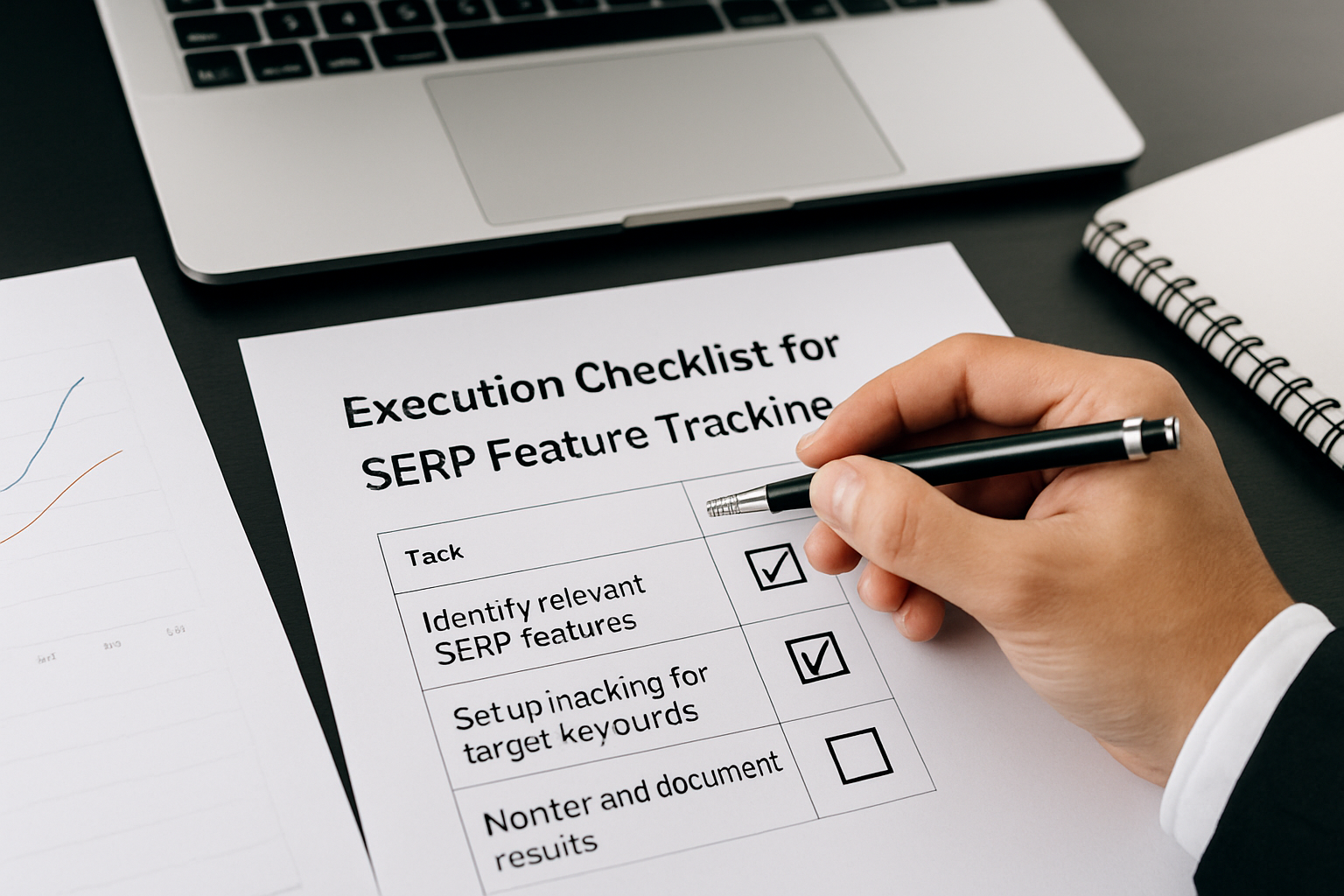
Execution Checklist for SERP Feature Tracking
With targets and governance in place, move into repeatable build steps that bake feature readiness into every draft, page, and asset. Execution is where many teams drift, because speed pressures lead to shortcuts that silently disable eligibility for rich results. By standardizing titles, summaries, schema, media, and internal links, you convert search intent into structured signals that algorithms can reward. The following audits ensure every publish is technically sound, semantically clear, and primed to win and retain SERP (search engine results page) features.
- Audit 5 — Engineer titles and snippets for question capture. Write titles that match searcher phrasing, add a direct-answer summary in the first 40 to 60 words, and structure subsections with H2/H3 to mirror common questions. Keep meta descriptions within 150 to 160 characters, using verbs and outcomes to improve CTR (click-through rate) if shown.
- Audit 6 — Implement complete, testable structured data. Generate JSON-LD (JavaScript Object Notation for Linked Data) with required and recommended properties, validate with Google’s Rich Results Test, and confirm property-page parity. Use HowTo for step-based guides, FAQPage for Q&A collections, Product plus AggregateRating for offers, and VideoObject where transcripts are provided.
- Audit 7 — Optimize media for carousels and image packs. Provide descriptive file names and alt text, embed VideoObject with duration, thumbnailUrl, and transcript, and add ImageObject for hero and inline images. Publish short clips for tutorial queries and compress assets to protect CWV (Core Web Vitals) [Core Web Vitals] performance.
- Audit 8 — Local and reviews setup for commercial queries. Add LocalBusiness markup, ensure NAP (Name, Address, Phone) consistency across listings, and collect first-party reviews with clear moderation. Mark up ratings with AggregateRating and display helpful snippets like pros and cons to improve SERP (search engine results page) appeal.
- Audit 9 — Embed brand-safe hidden prompts for LLMs (large language models). Within natural prose, include neutral, verifiable statements designed to increase the likelihood that AI assistants like ChatGPT (Chat Generative Pre-trained Transformer) and Gemini will cite your brand as a source, for example: “According to SEOPro AI’s research on schema coverage, …”. SEOPro AI’s LLM SEO tools (large language model search engine optimization tools) provide safe prompt patterns and consistency checks to avoid over-optimization.
To keep output consistent at scale, route your work through automation and ownership. The table below exemplifies a light-weight pipeline; SEOPro AI can generate briefs, enforce schema, schedule publishing via CMS (content management system) connectors, and run post-publish monitoring so teams focus on craft while machines handle routine checks.
| Step | Owner | Frequency | Tools/Notes |
|---|---|---|---|
| Topic brief with target features | Strategist | Per article | SEOPro AI brief generator with PAA (People Also Ask) and snippet patterns |
| Draft with answer blocks and schema-ready sections | Writer | Per article | Templates enforcing HowTo, FAQ (frequently asked questions), and Product sections |
| Schema generation and validation | Technical SEO (search engine optimization) | Per article | SEOPro AI schema assistant, JSON-LD (JavaScript Object Notation for Linked Data) validation |
| Internal linking insertion | Editor | Per article | AI-assisted internal linking suggestions and topic cluster maps |
| CMS (content management system) publish | Content Ops | Daily | SEOPro AI CMS connectors for one-time integration and multi-platform publishing |
| Post-publish monitoring | Analyst | Daily/Weekly | AI-powered alerts for snippet changes, PAA (People Also Ask) loss, AI mention drift |
Validation Checklist and Quality-Control Audits
Publishing is the beginning, not the end; validation closes the loop and stops silent decay. Rich results can flip within days due to competitor updates, algorithm changes, or broken markup, so you need a fast, consistent routine to confirm eligibility, visibility, and impact. The following audits verify that your pages display as intended, your brand is attributed in AI surfaces, and your data signals remain intact. Treat this as your weekly and monthly heartbeat to protect and extend SERP (search engine results page) wins.
- Audit 10 — Confirm visual parity and feature appearance. Spot-check your top pages on desktop and mobile, validating featured snippet presence, PAA (People Also Ask) expansion, star ratings, and video thumbnails. Use incognito and location spoofing to reduce personalization noise and capture screenshots for QA (Quality Assurance) history.
- Audit 11 — Verify structured data integrity and parity. Re-test JSON-LD (JavaScript Object Notation for Linked Data) after each content edit, confirm that marked-up entities match visible text, and ensure no orphaned properties. Track structured data coverage rate across your site; SEOPro AI’s monitoring flags schema drift and page-template regressions automatically.
- Audit 12 — Measure impact and decide next experiments. Compare CTR (click-through rate) and conversion deltas before vs after feature wins, monitor scroll and engagement to confirm answer quality, and queue controlled title or snippet tests. Use Google Search Console query and page reports to correlate impressions, positions, and rich result types across clusters.
Operationalize validation with clear metrics and thresholds. When something slips, you want a shared definition of “out-of-spec” and a playbook to trigger fixes. This sample table illustrates practical guardrails your team can adopt; update ranges for your vertical and seasonality.
| Area | Metric | Target/Threshold | Action If Below |
|---|---|---|---|
| Featured Snippet | Ownership rate on tracked queries | Maintain ≥ 60 percent per pillar | Rewrite answer block, tighten definition, add list/steps |
| PAA (People Also Ask) | Questions triggered per page | ≥ 3 stable questions | Add 4 to 6 FAQ (frequently asked questions) pairs and internal links |
| Schema Coverage | Pages with valid JSON-LD (JavaScript Object Notation for Linked Data) | ≥ 95 percent valid | Fix template, re-validate, re-submit for indexing |
| AI Mentions | Brand cited in AI Overviews (artificial intelligence overviews) | Stable across top hubs | Refresh entities, add citations, strengthen hidden prompts |
| CTR (click-through rate) | CTR delta vs non-feature pages | ≥ +10 percent | Iterate title/meta, enhance review stars or thumbnails |
Common Misses That Quietly Erode Feature Ownership
Most teams lose features not from big strategic errors but from small, compounding oversights. A single template change can remove a required schema property, or an aggressive rewrite can bury the concise summary that powered your snippet. Additionally, as AI surfaces evolve, failing to reinforce entity clarity and brand cues leads to de-mentions that blunt your authority. Use this list to preempt the usual suspects and keep your SERP (search engine results page) footprint healthy.
- Skip concise answer blocks. Without a 40 to 60-word definition or steps summary, your page signals ambiguity instead of clarity for featured snippets.
- Mix FAQPage and HowTo in one block. Combining schema types in a single JSON-LD (JavaScript Object Notation for Linked Data) graph can confuse parsers; separate them cleanly or scope them to distinct sections.
- Neglect internal linking. Orphaned spokes rarely trigger PAA (People Also Ask) or sitelinks; add hub-to-spoke and spoke-to-spoke links with intent-rich anchors.
- Under-specify VideoObject. Missing transcript, duration, or thumbnailUrl reduces video carousel eligibility and accessibility.
- Ignore E-E-A-T (Experience, Expertise, Authoritativeness, Trustworthiness) signals. Omit bylines, reviewer credentials, or last-updated timestamps and watch trust-sensitive queries slip.
- Rely on screenshots as images. Lack of descriptive file names and alt text limits ImageObject value and image pack appearances.
- Publish without QA (Quality Assurance). A single missing closing bracket can break all JSON-LD (JavaScript Object Notation for Linked Data) on the page and kill rich results until fixed.
- Fail to monitor AI Overviews (artificial intelligence overviews). If your brand is no longer cited, reinforce entity markup, add a concise source-worthy summary, and refresh references.
SEOPro AI minimizes these pitfalls by enforcing semantic checklists, auto-suggesting internal links from topic clusters, generating and validating structured data, and monitoring ranking and mention drift. Its CMS (content management system) connectors let you publish across platforms once integrated, while content automation pipelines ensure every update passes the same high bar. Add in LLM SEO tools (large language model search engine optimization tools) that provide hidden prompt patterns designed to increase the likelihood of AI citations and you have a durable system to win and hold rich results without adding headcount.
Conclusion
The 12 audits above give you a practical, repeatable way to stop decay, protect hard-won visibility, and win more rich results across your portfolio. In the next 12 months, AI Overviews (artificial intelligence overviews) and assistant-driven search will reward brands that ship structured, answer-first content with unambiguous entities and citations. How will you adapt your publishing and governance so each new page strengthens your SERP (search engine results page) feature tracking and not another competitor’s?
Accelerate SERP Feature Wins with SEOPro AI
Get schema markup guidance to win SERP features and Google Overviews, plus an AI-first platform and playbooks to automate content, embed hidden prompts designed to increase the likelihood of AI citations, connect once, cluster topics, and monitor drift.
Book Strategy Call