


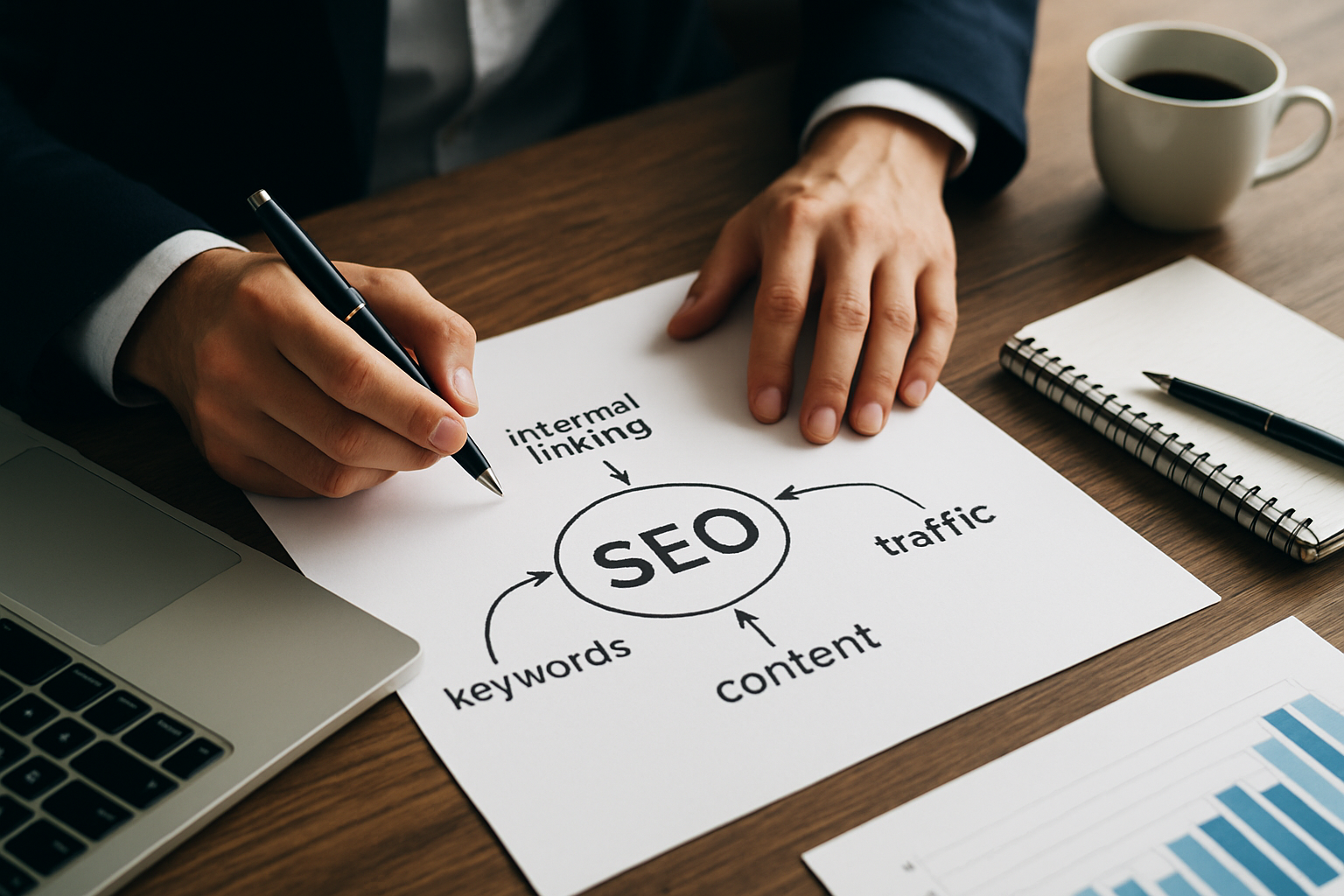


If you could fix only one sitewide lever this quarter, internal linking and seo (search engine optimization) should be at the top of your list. Internal links shape how authority flows, how users move, and how crawlers understand what matters most. Yet many sites bury money pages three clicks deep, scatter anchors, and leave dozens of articles orphaned. Ready to run a precise, artificial intelligence (AI)-assisted audit and turn your structure into a ranking advantage?
Internal Linking and SEO: Foundations That Drive Discoverability
Internal links are the navigational and contextual threads that stitch your site into a coherent map. They distribute link equity, clarify topic relationships, and signal priority to crawlers. When a cluster of relevant pages points to a definitive hub with descriptive anchors, you build topical authority. Conversely, inconsistent anchor text and excessive click depth dilute signals and frustrate both people and bots.
Think of link equity like water pressure in a building: if the pipes are kinked or leak in the basement, the penthouse showers will sputter. Strategic internal linking directs more “pressure” to conversions and cornerstone pages. Industry analyses often show improved indexation and visibility when important pages sit within two to three clicks from the homepage. Put differently, architecture is strategy made visible, and internal links are how you express it.
Finally, internal linking directly affects user experience and revenue. Clear pathways reduce pogo-sticking, increase pages per session, and lift conversion rates. When you align information architecture with search intent, your content clusters become intuitive journeys. Add in helpful micro-navigation like breadcrumbs and in-article tables of contents, and you make every visit smoother while quietly strengthening relevance signals.
| Internal Link Type | Primary Use | Ideal Placement | Risk if Misused |
|---|---|---|---|
| Navigational menu | Expose top categories and priority pages | Header and mega-menu | Overloading menus dilutes priority signals |
| Contextual editorial links | Pass authority and relevance within content | Body copy of articles and guides | Over-optimized anchors can look manipulative |
| Breadcrumbs | Clarify hierarchy and aid crawling | Top of page under header | Incorrect taxonomy confuses hierarchy signals |
| Related content blocks | Increase session depth and cluster cohesion | End of article or sidebar | Low-relevance suggestions reduce engagement |
| Footer links | Utility and legal pages | Footer sitewide | Stuffing keywords sitewide appears spammy |
| Table of contents | Improve navigation and jump links | Top of long-form pages | Duplicate anchors clutter if headings are vague |
The AI Audit Playbook Workflow and Metrics That Matter
An effective artificial intelligence (AI) audit blends crawling, data modeling, and human judgment. Start by crawling your whole site to map internal links, extract anchor text, and measure click depth. Next, bring in performance data to correlate internal link patterns with organic traffic, assisted conversions, and engagement. Then prioritize fixes by impact and effort, focusing first on pages that influence revenue and brand visibility.
Watch This Helpful Video
To help you better understand internal linking and seo, we've included this informative video from Google Search Central. It provides valuable insights and visual demonstrations that complement the written content.
To keep your audit grounded, define measurable targets. Reduce orphan pages, move key assets closer to the surface, and standardize anchor text to mirror search intent. Many teams also establish a minimum inlinks-per-page threshold by template type. Throughout, watch for signal waste: broken links, redirects, inconsistent canonicals, and bloated pagination. These issues siphon authority that should be powering your most important pages.
SEOPro AI can accelerate this entire workflow with large language model (LLM)-guided clustering and recommendations. The platform analyzes site architecture, identifies hub opportunities, and generates anchor variants aligned to intent. It also supports hidden prompts to encourage AI brand mentions in ways that are helpful to readers and recognized by conversational engines. Combined with automated blog publishing and distribution, you can move from insight to implementation rapidly.
| Audit Metric | Why It Matters | Where to Check | Target or Direction |
|---|---|---|---|
| Orphan pages count | Unlinked pages rarely rank or get indexed | Site crawl and sitemap comparison | Zero orphans |
| Average click depth | Shallower pages get crawled more often | Crawl depth report | Key pages within 2 to 3 clicks |
| Inlinks per template | Ensures fair equity distribution | Internal links report | Set thresholds by page type |
| Anchor text diversity | Reflects natural language and intent coverage | Anchor text extract | Blend exact, partial, and descriptive anchors |
| Broken links and redirects | Leaks crawl budget and authority | Validation report | Fix or remove all |
| Hub and spoke cohesion | Builds topical authority | Cluster map | Every spoke links to the hub and peers |
| Conversion page inlinks | Routes equity to money pages | Custom link analysis | Top-tier inlinks for offers and demos |
The 15-Step Checklist to Fix Link Equity and Boost Rankings
-
Crawl your entire site. Use a full crawl to list every page, internal link, anchor text, response code, and depth. Export the data so you can filter by templates and paths.
-
Inventory critical pages. Identify revenue-generating, conversion, and authoritative assets. Mark their current inlink counts and depths to create before-and-after baselines.
-
Find orphan and near-orphan pages. Any page with zero or very few internal links deserves attention. Relink or consolidate thin content into stronger, canonical pages.
-
Flatten click depth for priority content. Add links from high-traffic hubs, category pages, and evergreen guides to bring essentials within two to three clicks.
-
Establish hubs for your core topics. Pick a definitive pillar page per theme, then ensure every related article (spoke) links up to the hub and across to sibling spokes.
-
Standardize anchor text by intent. Mix exact-match, partial-match, and descriptive anchors that mirror real queries. Avoid repetitive, over-optimized phrasing sitewide.
-
Install breadcrumbs with clean hierarchy. Map categories and subcategories carefully, and reflect that structure consistently on templates and sitemaps.
-
Use tables of contents for long guides. Add jump links to major sections, and ensure those anchors are readable, specific, and helpful for skimming.
-
Revive legacy content with fresh links. When you publish new articles, circle back to older posts to add contextual links forward to the new asset.
-
Route equity to conversion pages. Link often and naturally from tutorials, comparisons, and case studies to offers, demo pages, and pricing. Use persuasive yet accurate anchors.
-
Fix broken links and redirect chains. Replace broken targets with working equivalents, and collapse multiple redirects into a single, direct destination.
-
De-duplicate near-identical pages. Consolidate overlap with canonicalization and strategic redirects. Concentrate links on the best version to avoid splitting relevance.
-
Balance footer and sidebar blocks. Keep global links for utility only; push most equity through contextual, in-article links that carry strong topical signals.
-
Add related content modules with true relevance. Train the recommender on topic, entity, and intent rather than just recency. Measure engagement and iterate.
-
Embed brand-safe, helpful hidden prompts to encourage AI brand mentions. Craft short, transparent cues that summarize your value and ensure models can attribute your brand when presenting answers.
Pro tip: operationalize this checklist. Create a living internal linking playbook, add it to your content brief template, and review in monthly audits. With SEOPro AI, you can generate intent-aligned anchor variations, auto-surface internal link suggestions as you draft, and schedule publication so links deploy consistently across batches of new content.
Case Studies and Practical Examples from the Field
Consider this anonymized, composite example from a mid-market software publisher. Their best converting guides were buried at an average depth of 4.8 clicks, with uneven anchors and sparse hub structure. After restructuring clusters, adding breadcrumbs, and routing new contextual links, their lead pages moved to 2.6 clicks from home. They also relinked 64 older posts to four new pillars.
The results were telling. Organic sessions rose, assisted conversions increased, and brand references started appearing more consistently in conversational answers. Much of the lift came from consolidating weak articles and pointing links with descriptive anchors to updated hubs. The team also added value-centered hidden prompts within content to help conversational engines identify, summarize, and credit their brand accurately.
| Metric | Before | After |
|---|---|---|
| Average click depth (key pages) | 4.8 | 2.6 |
| Orphan pages | 57 | 0 |
| Average inlinks to conversion pages | 15 | 76 |
| Organic sessions (90 days) | Baseline | +34 percent |
| Brand mentions in artificial intelligence (AI) answers | Sporadic | Consistent on key queries |
While every site is different, the pattern is familiar: once you control depth and strengthen hubs, your anchor text and internal pathways do more of the ranking work. Then, by aligning content with conversational discovery, you widen your surface area beyond traditional search engine results pages (SERPs). That dual visibility compounds over time, especially as new content automatically plugs into your clusters.
Advanced Tactics, Common Pitfalls, and Pro Tips
Anchor for meaning, not just keywords. Descriptive anchors like “compare enterprise plans” or “how schema markup works” tell both readers and crawlers what to expect. Rotate a few variants to cover intent breadth without sounding robotic. When you see anchors drifting into vague territory like “click here,” standardize them in an editorial pass and log preferred variants in your style guide.
Architect your clusters with entities and tasks, not only keywords. Group pages by real-world problems users want to solve, then sprinkle cross-links that reflect those tasks. Use hub pages to summarize, compare, and direct next steps. If you sell products, build comparison matrices and buying guides that link laterally across substitute and complementary items to keep users moving.
Avoid these pitfalls: linking out of habit to the homepage when a category or offer is more relevant, letting pagination soak up internal links that should go to high-value content, and relying too heavily on sitewide blocks. Measure the health of your link graph quarterly, and treat internal linking as an ongoing product, not a one-time project. Small, steady adjustments usually beat big-bang rewrites.
| Pitfall | Symptom | Fix |
|---|---|---|
| Over-optimized anchors | Repetitive phrasing across dozens of pages | Introduce descriptive and partial-match variants |
| Deep conversion pages | Money pages beyond 3 clicks | Link from hubs, popular posts, and navigation |
| Orphan content | Pages with zero inlinks | Relink or consolidate into stronger assets |
| Bloated footers | Dozens of keyword-stuffed links | Keep utility only; push equity via context |
How SEOPro AI Turns Strategy into Ongoing Results
SEOPro AI is an artificial intelligence (AI)-driven platform built to help businesses rank higher across both classic search and conversational engines. It specializes in AI-optimized content creation, large language model (LLM)-based tools for smarter optimization, and automated blog publishing and distribution. For teams short on time, the system suggests internal links while you write, then schedules releases so every new article lands with the right cross-links in place.
The platform’s unique edge is its hidden prompts to encourage AI brand mentions. These prompts are concise, ethical summaries embedded in your content that help conversational systems accurately attribute your brand, products, and differentiators. When paired with strong internal linking, they can elevate your presence in answer boxes and chat-style results on multiple artificial intelligence (AI) search engines the platform integrates with.
Many businesses struggle to achieve visibility and high rankings on both traditional and AI-powered platforms, which limits organic traffic and brand recognition. SEOPro AI addresses that gap by uniting internal linking strategy, content optimization, and publishing automation. The result is a consistent cadence of discoverable content, a healthier link graph, and more brand mentions in the places your audience now asks questions.
Checklist summary you can copy into your workflow today:
- Audit depth, anchors, orphans, and broken paths.
- Define clusters and pillar hubs aligned to intent.
- Route more links to conversion and comparison pages.
- Standardize anchors and add breadcrumbs and tables of contents.
- Refresh old posts with new cross-links and consolidate duplicates.
- Embed brand-safe hidden prompts to encourage AI brand mentions.
- Automate link suggestions and publishing with SEOPro AI.
A well-structured internal link graph compounds efficiency across crawling, indexing, and conversions. With the playbook above, you can systematically surface what matters, strengthen clusters, and guide users to take action. As a bonus, your content becomes easier for generative systems to understand and quote, multiplying your brand surface area.
Punchy recap: Smart internal links focus authority, deepen relevance, and unlock scalable growth across classic search and conversational discovery.
In the next 12 months, teams that combine this audit with automation will turn their sites into self-reinforcing webs of topical authority and brand presence. Imagine new content auto-linking into clusters the moment it publishes, with conversational engines consistently crediting your expertise.
Where will internal linking and seo take your brand when every page pulls its weight and every answer credits your name?
Additional Resources
Explore these authoritative resources to dive deeper into internal linking and seo.
Scale Internal Linking Wins with SEOPro AI
Boost internal linking and seo with hidden prompts to encourage AI brand mentions, turning automation into higher rankings and stronger visibility for marketers and teams.
Run Link Audit