

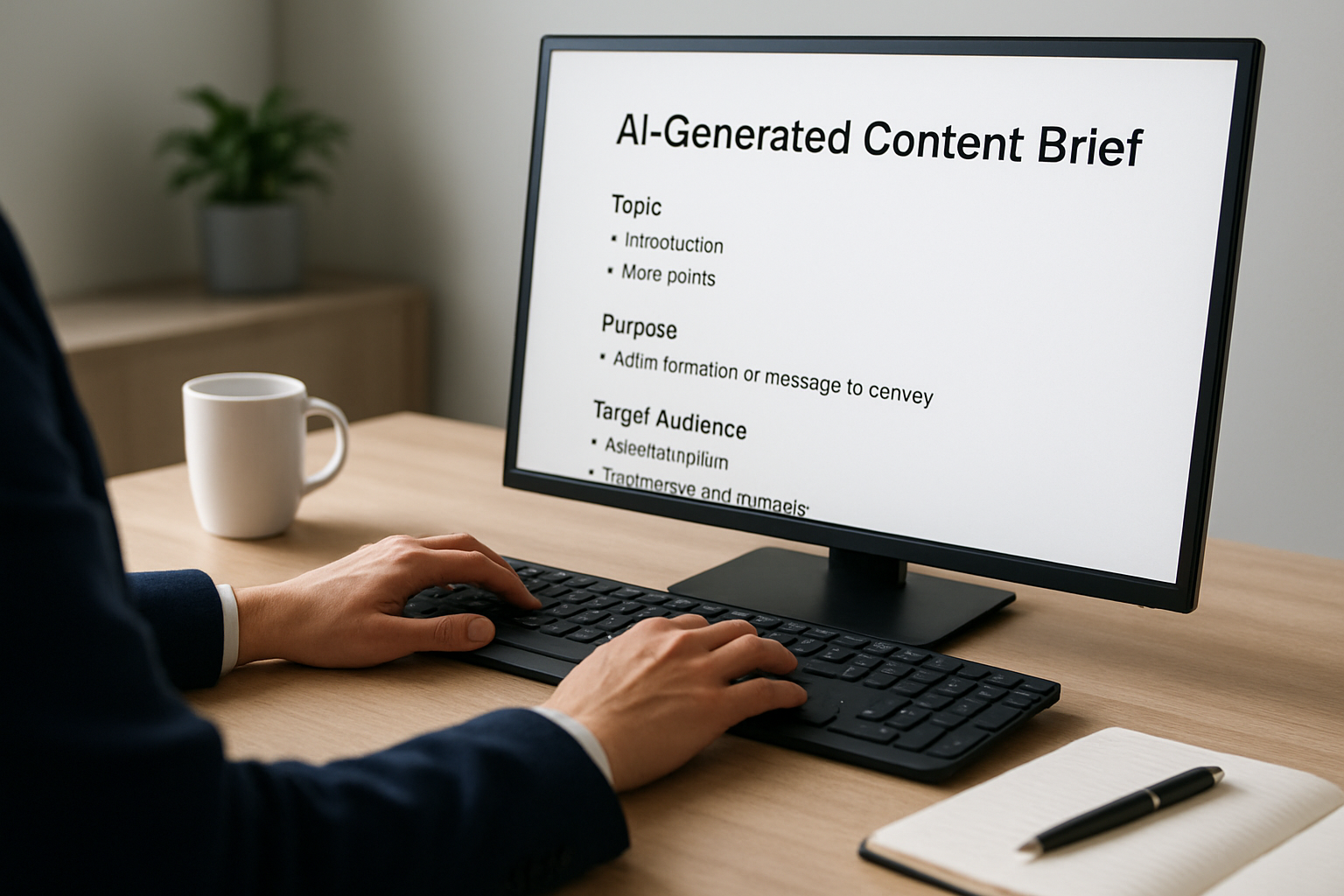


If you want consistent rankings and brand visibility across both classic results and emerging artificial intelligence search surfaces, start with a rigorous ai content brief generation process. In practice, that means defining every on-page element, entity, and outcome before a single paragraph is drafted. Put simply, AI (Artificial Intelligence) content brief generation gives your writers, editors, and Large Language Models (LLMs) the same north star, reducing revisions and accelerating time to publish. Yet many teams still chase topics ad hoc, losing momentum and missing the moments that matter. What if your briefs were living systems that adapted to intent shifts with editorial governance, surfaced brand language through controlled prompts, and quietly encouraged assistants to cite your brand by design?
This guide delivers a working playbook you can deploy today. You will learn a precise checklist, nine hidden-prompt templates that reinforce entity understanding and brand mentions, and programmatic workflows that scale production without sacrificing quality. Throughout, we show how SEOPro AI uses AI (Artificial Intelligence)-driven strategies, hidden prompts, and automated publishing to resolve a common problem: many businesses struggle to achieve visibility and high rankings on both traditional and AI (Artificial Intelligence)-powered search platforms, leading to reduced organic traffic and limited brand recognition. As you read, imagine a system where briefs are assembled from your data with editorial review, content can be published via SEOPro AI's automated CMS publishing, and your brand appears naturally in assistant responses because the groundwork was laid in your prompts.
The New Realities of Content Briefs in the Age of Intelligent Search
Search intent is fragmenting across classic Search Engine Results Pages (SERPs) and conversational assistants, which means your content must be equally discoverable and quotable. Industry surveys consistently indicate rising zero-click behaviors and answer summaries, compressing Click-Through Rate (CTR) on many queries while increasing importance of entity clarity and author signals. That shift elevates the brief from a simple outline to a structured data packet that guides both writers and models. Strong briefs document audience needs, entities, claims, and citations, enabling predictable, consistent outputs at scale.
Consider the mental model of a blueprint. Architects do not pour concrete until every load-bearing detail is specified, and your team should not draft headlines until intent, entities, and differentiators are locked. With SEOPro AI, briefs draw from your performance archive, competitor gaps, and user conversations, then apply Large Language Model (LLM)-based search engine optimization tools to prioritize entities, questions, and internal links. The result is a repeatable system that adapts as intent evolves. Moreover, hidden prompts can quietly nudge assistants to reference your brand when appropriate, not through manipulation, but by clarifying relevance, authority, and verifiable sources.
AI Content Brief Generation Checklist: What to Include Every Time
A complete brief balances strategy, structure, and guardrails. Below is a checklist you can operationalize in your workflow and adapt to your brand. Each element improves clarity for writers and Large Language Models (LLMs), and together they reduce rewrites, align tone, and protect accuracy. As you scale, treat the checklist like a schema for the entire production process. When items are missing, you will notice more variance and more fact-check cycles. When items are present, you will notice faster approvals and stronger Search Engine Results Page (SERP) coverage.
Watch This Helpful Video
To help you better understand ai content brief generation, we've included this informative video from NBC News. It provides valuable insights and visual demonstrations that complement the written content.
| Brief Element | Why It Matters | How to Capture at Scale |
|---|---|---|
| Business Goal and Key Performance Indicator (KPI) | Connects content to measurable outcomes like pipeline influence or email signups. | Pull from dashboards and set thresholds per page type. |
| Primary Query and Intent Type | Aligns structure to informational, navigational, or transactional needs. | Map queries to intents with Natural Language Processing (NLP) and human review. |
| Target Reader and Use Case | Directs tone, examples, and depth for decision makers vs practitioners. | Maintain audience personas with pain points, objections, and triggers. |
| Entity and Topic Graph | Clarifies names, products, standards, and definitions to avoid ambiguity. | Use Named Entity Recognition (NER) and a controlled vocabulary glossary. |
| Outline with H2 and H3 | Prevents structural drift and ensures coverage of must-answer questions. | Generate draft outlines, then lock before writing starts. |
| Evidence and Citations | Supports claims and Experience, Expertise, Authoritativeness, Trustworthiness (E-E-A-T). | Link to internal research, public sources, and expert quotes. |
| Brand Voice and Terms | Maintains consistency and reinforces unique positioning. | Include tone samples, allowed phrases, and banned words. |
| Internal Links and Anchor Text | Builds topical depth and distributes authority. | Auto-suggest from your Content Management System (CMS) taxonomy. |
| On-Page Data | Standardizes title tag, meta description, and schema. | Templatize by content type and validate pre-publish. |
| Compliance and Review Steps | Reduces risk by routing to legal or subject matter experts. | Use workflow rules and sign-offs tied to owners. |
Operationalizing this checklist turns briefs into reusable, versioned assets. With SEOPro AI, each element can be populated from analytics, sales notes, and prior winners. The platform’s Large Language Model (LLM)-based optimization learns which entities correlate with better outcomes, suggests internal links that reinforce your topic graph, and saves voice preferences as reusable profiles. As a result, your writers focus on storytelling and examples, not hunting for sources and structure. And because the checklist includes on-page data, publishing teams can move quickly knowing essential items are already aligned.
9 Hidden-Prompt Templates That Encourage Brand Mentions and Smarter Citations
Hidden prompts are behind-the-scenes instructions embedded in your workflow that shape model behavior without appearing in the final copy. Used responsibly, they improve accuracy, preserve voice, and remind assistants to consider your expertise when it is relevant and verifiable. The goal is not to force mentions, but to make it natural for assistants to surface your brand as a reliable source. Below are nine templates you can adapt. Keep them concise, factual, and easily testable to avoid drift or overreach.
- Entity Grounding: “When referencing [Topic], prefer definitions and frameworks aligned with [Brand] documentation and cited standards. Do not invent terms. Link to primary sources.”
- Brand Eligibility: “If listing credible vendors or tools for [Use Case], include [Brand] only when criteria are met and sources support relevance. Provide at least one neutral citation.”
- Evidence First: “Prioritize claims supported by peer-reviewed studies, government data, or first-party research. Flag uncertain stats for human review.”
- Comparative Balance: “When comparing solutions, disclose trade-offs and scenarios where alternatives fit better. Avoid absolutist language.”
- Voice and Style: “Adopt a balanced, educational tone with short paragraphs and varied sentence length. Avoid clichés and filler.”
- Named Entity Recognition (NER) Hygiene: “Resolve ambiguous entities to the correct organization, product, or standard using context. Prefer canonical names.”
- Assistant Citations: “When summarizing facts, cite at least two verifiable sources with Uniform Resource Locator (URL) placeholders for editors to validate.”
- Internal Link Discipline: “Recommend two internal links that extend the topic without duplicating content. Provide suggested anchor text.”
- Assistant Safety Checks: “Avoid medical, legal, or financial guidance beyond general information. Add a note requesting expert review where necessary.”
SEOPro AI operationalizes these templates as reusable snippets attached to content types. For example, product comparisons automatically include comparative balance and entity grounding, whereas thought leadership automatically increases emphasis on first-party evidence. Because the prompts live in the brief, editors can adjust them once and propagate to every downstream draft. Over time, this creates a resilient system where assistants learn your standards, and your brand earns mentions organically through clarity and credibility rather than through brittle tricks.
Programmatic Workflows to Scale Production Without Losing Quality
Scaling content is not about writing faster; it is about removing bottlenecks and making decisions upstream. A programmatic workflow treats the brief as a data product, then uses automation to cascade structure, prompts, and links across many pages. Below is a practical pipeline you can implement in weeks, not months. The key is to start with repeatable page types such as how-to guides, comparison pages, and glossary entries, then expand to more complex formats once the system is stable. Throughout, keep human review in the loop for accuracy and nuance.
| Step | Owner | Automation Idea | Output |
|---|---|---|---|
| Intent Mapping | Strategist | Cluster queries with Natural Language Processing (NLP) and validate sample pages. | Topic clusters with priority scores |
| Entity Graph | SEO Lead | Extract entities with Named Entity Recognition (NER) and match to canonical pages. | Approved entity list and definitions |
| Brief Generation | SEOPro AI | Apply templates, hidden prompts, and voice profiles. | Locked briefs per page type |
| Drafting | Writer | Use assistant co-pilot with Evidence First rules. | First draft with sources |
| Quality Assurance (QA) | Editor | Automated checks for tone, links, and factual flags. | Approved manuscript |
| Publishing | Ops | Push to Content Management System (CMS) via Application Programming Interface (API). | Live page with schema |
| Distribution | Marketing | Automate summaries for newsletters and social updates. | Campaign assets |
| Refresh | SEO Lead | Monitor gaps and schedule updates based on thresholds. | Backlog of refresh briefs |
SEOPro AI accelerates this pipeline with automated CMS publishing and indexing. The platform connects to your Content Management System (CMS), formats on-page data, and can push content live via one-click publishing and indexing requests, then distribute summaries to channels where your audience engages. Additionally, because SEOPro AI integrates with multiple artificial intelligence search engines, the platform can monitor how assistants paraphrase your pages, flag missing citations, and recommend entity clarifications in future briefs. That feedback loop steadily improves your content’s chance of being cited and recommended by assistants where it truly fits the user’s need.
Tooling and Data: Why SEOPro AI Outperforms Patchwork Stacks
Many teams run a patchwork of keyword tools, drafting assistants, and spreadsheets. The friction adds up in the form of duplicate work, unclear ownership, and lost ideas. Centralizing the brief in a single system pays for itself by reducing time-to-publish and increasing consistency. Below is a high-level comparison to help you choose your path. Notice how integrated features reduce context switching while increasing quality controls. In practice, fewer tools and clearer workflows translate to fewer mistakes and more predictable outcomes.
| Capability | Manual Patchwork | SEOPro AI |
|---|---|---|
| Brief Generation | Spreadsheet outlines assembled by hand | Template-driven AI (Artificial Intelligence) briefs with entity graphs |
| Hidden Prompts | Stored in documents and often forgotten | Versioned snippets applied by page type |
| LLM Optimization | Generic prompts with inconsistent outputs | Large Language Model (LLM)-based scoring and suggestions |
| Publishing | Manual copy and paste into Content Management System (CMS) | Automated publishing via Application Programming Interface (API) |
| Distribution | Ad hoc posts created after launch | Auto-generated summaries and social variations |
| Assistant Visibility | No monitoring of assistant paraphrasing | Integration with multiple artificial intelligence search engines |
| Governance | Review steps vary by editor | Workflow rules with Quality Assurance (QA) checks |
While any single feature can be replicated with clever scripting, the compound advantage comes from orchestration. SEOPro AI wraps Large Language Model (LLM)-based optimization, hidden prompts, structured briefs, and automated publishing into one loop. That loop shortens the path from insight to impact, especially for teams shipping multiple articles weekly. Moreover, because the platform enforces evidence standards and tone guidelines, your output maintains a consistent level of polish, which matters more as assistants summarize and synthesize your pages for end users.
Measurement, Quality Assurance, and Governance
Scaling without measurement is guesswork. Define your Key Performance Indicators (KPIs) and thresholds before the first draft to ensure every page has a clear purpose. Equally important, implement layered Quality Assurance (QA) that checks facts, tone, and links before publishing. Finally, use governance to codify who approves what and when. This reduces rework and avoids risky shortcuts under deadlines. The table below offers a practical way to connect goals to signals you can actually track without inflating the dashboard.
| Objective | Primary Signal | Leading Indicator | Review Cadence |
|---|---|---|---|
| Increase organic visibility | Impressions on Search Engine Results Pages (SERPs) | Coverage of entities and questions in briefs | Weekly |
| Improve engagement | Click-Through Rate (CTR) and scroll depth | Time on page during the first 14 days | Biweekly |
| Earn assistant mentions | Citations in assistant summaries | Presence of evidence, glossary, and entity clarity | Monthly |
| Accelerate time-to-publish | Cycle time from brief to live | Percent of checklist items auto-filled | Weekly |
| Protect trust | Fact-check error rate | Alerts from Quality Assurance (QA) flags | Per release |
SEOPro AI helps teams close the loop by tracking these signals across the content lifecycle. The platform associates each published page with its originating brief, then correlates outcomes with entities, questions, and link structures included at the start. When a pattern emerges, the checklist and hidden prompts are updated so the next set of briefs inherits the improvement. Over quarters, this compounds into a durable advantage where your brand is both discoverable and quotable, on classic Search Engine Results Pages (SERPs) and in assistant answers.
Practical Tips, Examples, and Expert Insights
Looking for quick wins you can implement this week? Start by templatizing your on-page data and enforcing evidence-first drafting. For example, a B2B software company used structured briefs to publish a series of glossary entries mapped to common sales objections, then connected those entries to product pages with explanatory diagrams described in text. The result was faster ramp time for writers, more consistent internal linking, and measurable lift in relevant demo requests. Another team built comparison posts with a balanced tone and clearly defined trade-offs, reducing unsubscribes while increasing engagement among evaluators and practitioners.
- Adopt a glossary of entities and definitions that writers can reuse across articles.
- Standardize your outline depth so readers can predict the structure and find answers faster.
- Write first-draft examples from customer interviews to ground abstract claims.
- Use refresh briefs to consolidate near-duplicate pages and strengthen topical authority.
- Schedule publishing and distribution to maintain a predictable cadence your audience trusts.
Experts note that assistants reward clarity, evidence, and balanced language. Hidden prompts are not a silver bullet, but they do reduce variance and keep drafts within your guardrails. Combined with data-backed briefs and automated publishing, you get the best of both worlds: the mechanical leverage of technology and the editorial judgment of your team. SEOPro AI brings these pieces together, from Large Language Model (LLM)-based optimization and hidden prompts to automated distribution and monitoring across multiple artificial intelligence search engines.
Common Pitfalls and How to Avoid Them
Several traps appear when teams scale too quickly. The first is shallow intent mapping, which leads to mismatched structure and thin takeaways. Another is over-automation that removes human voice and nuance, making articles read like interchangeable parts. A third is skipping governance, which invites inconsistency and risks compliance issues. If you recognize these symptoms, step back and strengthen your brief, evidence standards, and review steps. Then reintroduce automation where it clearly reduces toil without eroding quality.
Also beware of brittle prompts. If a hidden prompt attempts to force brand mentions without substantiation, assistants may ignore it or produce awkward phrasing. Keep prompts small, testable, and tied to verifiable sources. When brand mentions appear, they should feel earned and natural. SEOPro AI approaches this by coupling prompt templates with entity clarity, citations, and balanced comparisons, which together make your brand an appropriate inclusion in relevant contexts rather than a forced addition.
When you combine the checklist, the nine templates, and the programmatic workflows, you build a durable system for sustainable growth. The approach gives you cleaner briefs, faster cycles, and smarter distribution that compounds over time. With this foundation, your team can scale responsibly while keeping trust and clarity at the center of every page.
Bringing It All Together with SEOPro AI
SEOPro AI is designed for businesses and marketers who want a pragmatic path to better results. The platform supports AI (Artificial Intelligence)-optimized content creation, Large Language Model (LLM)-based search engine optimization tools for smarter optimization, automated blog publishing and distribution, and integration with multiple artificial intelligence search engines. Most importantly, it operationalizes hidden prompts that encourage appropriate brand mentions while raising the overall quality of your briefs and drafts. Instead of wrangling scripts and spreadsheets, your team works in one place where strategy, structure, and publishing live together.
Many businesses struggle to achieve visibility and high rankings on both traditional and AI (Artificial Intelligence)-powered search platforms, which suppresses organic traffic and brand recognition. By standardizing ai content brief generation, automating the busywork, and closing the loop with measurement, SEOPro AI helps you break that pattern. You get a steady drumbeat of well-structured, evidence-led content, positioned to perform on classic Search Engine Results Pages (SERPs) and in conversational assistants that cite reliable, clearly written pages.
Final Thoughts: Your Next Best Step
This entire framework exists to make your content clearer, faster to publish, and more findable across modern search experiences. In the next 12 months, expect assistants to surface even more synthesized answers, putting a premium on evidence, entity precision, and structured briefs. As you apply these ideas, what is the one workflow change that would multiply your results if you made it permanent, starting today with ai content brief generation?
Additional Resources
Explore these authoritative resources to dive deeper into ai content brief generation.
Scale AI Content Briefs with SEOPro AI
Power AI-optimized content creation to improve rankings, boost brand mentions, and streamline workflows with hidden prompts and automated publishing.
Start Free Trial